/
Neuromarketing with Katie Hart
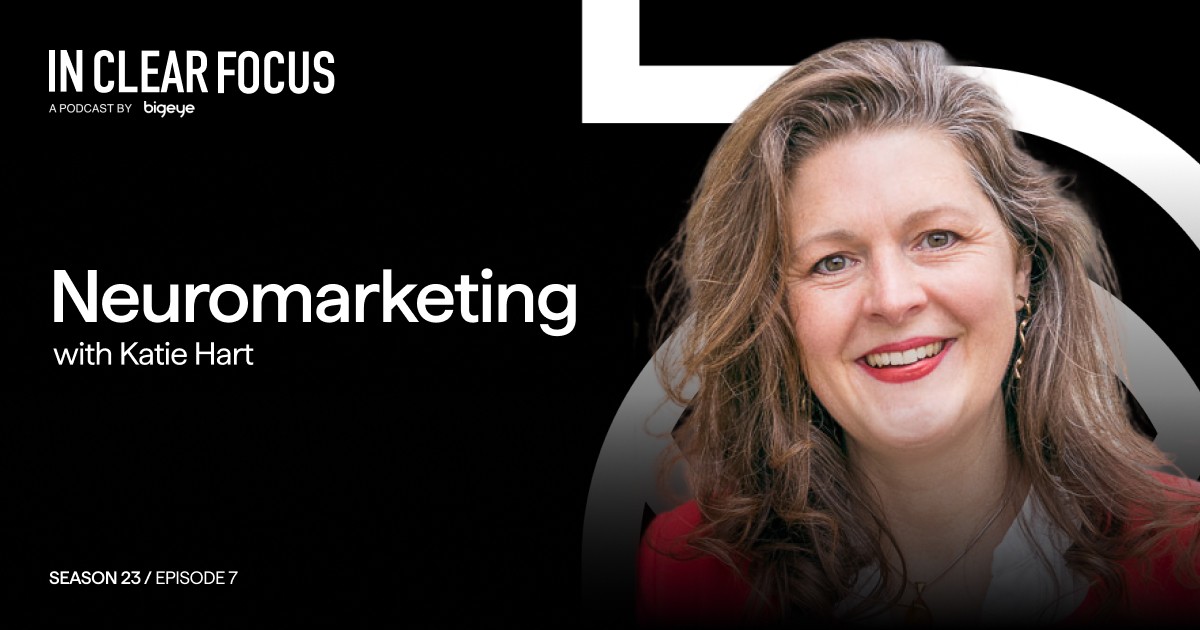
IN CLEAR FOCUS: June's Bigeye Book Club selection is "Neuromarketing: Practical Insights for Improving Customer Engagement." Author Katie Hart explains why, when 95 percent of purchase decisions are non-conscious, traditional research often asks the wrong questions. Learn how neuromarketing reveals real consumer behavior, why brains process images faster than text , and the physiological impact of 2D screens. We also discuss Katie's practical framework for transforming B2B and B2C strategies.
Episode Transcript
Adrian Tennant: Coming up in this episode of IN CLEAR FOCUS:
Katie Hart: There is no part of our brain that is designed or dedicated to processing information about brands. So a lot of the mechanisms and the processes we use are those that are laid down for relationships. So the more human that we can show our brands to be, the easier it is for brains to be able to engage with them, understand them, feel that they are seen and feel that they are understood.
Adrian Tennant: You're listening to IN CLEAR FOCUS, fresh perspectives on marketing and advertising, produced weekly by BigEye, a strategy-led, full-service creative agency growing brands for clients globally. Hello, I'm your host, Adrian Tennant, BigEye's Chief Strategy Officer. Thank you for joining us. Marketers and research teams have a well-established toolkit for understanding consumers, quantitative surveys for scale, and qualitative focus groups and in-depth interviews for nuance. But these primary research methods share a limitation. They can only capture what the customer is consciously aware of, which is why they're known as self-reports. But what about the parts of the consumer decision-making process that happen non-consciously, in ways customers themselves can't easily access? Our guest today has spent more than 15 years at the intersection of neuroscience, psychology, and marketing, translating what the brain actually does into information marketers can use. Katie Hart is an international speaker, trainer, and researcher. She holds a Master's in Applied Neuroscience from King's College London, is a Fellow of the Chartered Institute of Marketing, and serves as Customer Insights Tutor at Cambridge Marketing College. Through her consultancy, Katie Hart Limited, she's delivered neuromarketing research and training for international brands, including Honda and Dove. Katie's new book, published by Kogan Page, is "Neuromarketing: Practical Insights for Improving Customer Engagement." The Bigeye Book Club selection for June, Katie's book translates academic neuroscience into a practical playbook for marketers who want work grounded in how people actually think, feel, and decide. To discuss how neuroscience is reshaping the way brand marketers approach consumer behavior, and what those insights mean in practice, I'm delighted that Katie is joining us today from Cambridge in the UK. Katie, welcome to IN CLEAR FOCUS.
Katie Hart: Thank you very much. It's lovely to be here.
Adrian Tennant: Well, first of all, congratulations on the publication of "Neuromarketing." What prompted you to write this book now?
Katie Hart: Great question. In a way, there is never a completely right time to write a book on neuroscience because there is always so much that we are learning. It's very much an ongoing journey. However, I think what tipped things for me is the emphasis within the marketing profession at the moment on what feels very automated. We're looking at AI, we're looking at algorithms, and to me, we were losing sight of the human element. And that's something I'm really passionate about, is reminding marketing professionals that ultimately, the other side of the content, the campaigns that they are creating, there is a human brain. So really, that's what motivated me to release the book now.
Adrian Tennant: One of the central insights in your book is that around 95% of what drives a purchase decision happens below consumers' conscious awareness. When marketers first hear that figure, many push back hard. Why is that idea just so difficult for us to absorb?
Katie Hart: I don't think it's just marketers, I think it's all of us. As humans, we fall for the illusion that we are aware of everything, that we are sort of in control of what goes into making the decisions that we take on a day-by-day basis, regardless of whether they're sort of small, what might feel like inconsequential decisions, or even the really big, significant ones about whether to accept a marriage proposal or move to a different country. It's hard for us all. And I think particularly within marketing, many of us over the years have been taught it's really important for us to understand our customers and to ask our customers what they want and to capture feedback from our customers. So perhaps for us, there is that additional level that has been sort of drilled into us over the years of really working closely with our customers and taking what they tell us at face value, taking that as being the true situation. So when we start to challenge that, it becomes much less comfortable for all of us.
Adrian Tennant: If most of what drives consumer choice is happening below the conscious threshold, then a great deal of conventional market research, such as surveys, focus groups, and stated preference work, could be asking people about the wrong things in the wrong kinds of ways. So Katie, where does that leave the methods most marketers still rely on every day?
Katie Hart: It still has value, definitely. And when I'm working with organizations, I still encourage them to actively do that. Lots of reasons. I think, firstly, it's important to customers to feel that they are being listened to. So it is nice to get that interaction and that two-way communication. But what I always recommend is that people focus on what the customers can be relied on to report accurately. So if they're describing circumstances or situations, if they're reporting frequency with which they undertake behaviors, they can be much more reliable. The other point is that actually listening to how they articulate the situations is really critical, and that gives us a rich pool of information in terms of the phrasing and the language and the descriptors that they use, which we can then tap into for our own content. So there's still lots of reasons to go out there and do that. But where it becomes less reliable is when we start asking them things like why they do something, how they feel about something and notoriously what they will do. So will they buy brand A or brand B? We've known for years that we are notoriously unreliable at being able to report what our future behaviors will actually be. So it's just playing to where those existing market research techniques have strengths. and then recognizing the areas where that reliability starts to drop off a cliff.
Adrian Tennant: Physiological research tools such as electroencephalography, eye tracking, and galvanic skin response used to sit firmly inside specialist research labs. A decade ago, to capture research participants' non-conscious biometrics, I was using hardware and software that required very careful setup and calibration. And the training on how to set up and use the tools, and of course, interpret the results was non-trivial. So fast forward to 2026, how accessible are these methods for the average brand or agency team that wants to bring this kind of evidence into their work?
Katie Hart: Things have definitely improved since you and I first started using these techniques and these fabulous resources. And I think one of the biggest factors is that the resources are now much more portable. So, typically, when we first started using EEG, we had to bring somebody into a laboratory environment, and they were wearing the equivalent of sort of swimming hats which had huge trunks of wiring that connected them to a machine. It's no longer like that. So we do actually have the opportunity to go out and to take the equipment out. But you're right, it isn't appropriate for everybody to be trying to do that. So although things have improved, I still think it needs careful consideration. If an agency or an organization sees this very much as being a future they want to invest in, it might be worth bringing in that resource into their sort of in-house team or training up somebody within that team. But if not, all is not lost. So there are things that we can do that will improve on their existing offering. It will improve the accuracy of what they're currently producing. Accepting it won't be as great as having somebody do the work for themselves. So there are AI solutions which can help, particularly things like eye tracking. They've got quite good at mapping out. And of course, the other fabulous thing is that over the years, there has been a growing mass of knowledge and understanding and data and research that is very much shared within the industry. So again, it may not be directly relevant to their particular creative, to their particular strategies, but they can still learn what has worked, what has been discovered from other neuromarketing research. and perhaps try A-B testing or something to really bring those nuances into effect with their own work. So it's improving. Yes, it's not universally accessible yet.
Adrian Tennant: As regular listeners know, we love case studies on IN CLEAR FOCUS. So Katie, could you walk us through some client work where applying neuroscience principles produced a measurably different commercial outcome than a conventional approach would have?
Katie Hart: Yeah, with great pleasure. The first was one where we were looking at repositioning a brand. Now, this was a brand that had been purchased by a company. Because the brand was struggling, it wasn't really viable in its current format, and they were a competitor. So the company decided to acquire them and bring them in. And what they wanted to do was understand which parts of the brand they could play with, which parts were okay to be adapted, manipulated a bit, to make it a more viable prospect. And which parts of the brand the existing customer base felt very attached to, because it did have a fabulously loyal customer base. We did some work exploring the brand and people's reaction and relationship with the brand. And then we started to turn that into looking at different fonts, different taglines they could use, different color palettes even. And so when the brand was relaunched, we got real confidence in the position that we were taking forwards for them. And in that particular instance, the day that their brand was launched, they opened their new season and they had the biggest sale record that they had achieved in the 43-year history of the company. So, that was phenomenal. That was a lovely example of how we were able to extract different elements of a particular brand and really optimize those. The second example that just shows a completely different direction was one I worked on a couple of years ago, and it was exploring the issue of encouraging people back into the workplace, having worked remotely. We were wanting to interview people about what is essentially quite a sensitive topic, and we were aware that there may be biases. We all have preferences for whether we like working from home, you know, in our pajamas or whatever we might be doing. Or actually, whether we like the stimulation and we like the opportunity to come into the office. So bringing EEG research into that was fabulous. And what we actually did was conducted interviews with people whilst they were wearing the EEG headsets. So, we've got two sets of data. We've got what they were overtly reporting and what we were picking up physiologically. And as happens so often, we end up with very different results. And we know that the physiological response is the one that gives us the more accurate predictor of human behaviour. But what was really interesting for me was through the physiological responses, we picked up on a really significant, impactful factor which was never mentioned in any of the conversations, in any of the discussions. It took a completely different turn and a completely different direction in terms of what people felt about being in the office. And so it just literally opened up a whole new dimension for the owners of that research, which would never have materialized if we hadn't been able to use the physiological neuroscience techniques
Adrian Tennant: It's fascinating, isn't it?
Katie Hart: I'm biased, but I love it.
Adrian Tennant: Katie, your book makes the point that humans process images far faster than text, something like 77 images per second, versus around four words per second. What does that asymmetry mean in practical terms for how brand marketers should think about the balance between visual and verbal in their creative?
Katie Hart: I think this is probably touching on something that most of us know at a fundamental level, but then always choose to forget. I think any of us that have had young children or been around people who are learning to read know how hard it is. And that's simply because parts of our brain are having to be effectively recycled, repurposed if you like, because reading is not something that is natural within our brains. So, it is something that our brain finds draining and very very much like hard work. So if at all possible, the brain chooses not to do it. And certainly, when it comes to capturing information, it will prioritize visual information first. Because it's easy, because we do have areas of our brain that are dedicated to very quickly making sense of our visual environment around us. So for marketers, I think very often we get caught up in the copywriting, and I'm not dismissing that. It's a fabulous skill and we all need to have it. But in order to get that copy read, we very often want to work hard in terms of selecting appropriate imagery to capture the attention of our audience. If we think about it, the environment that we're all in these days is so busy, it's so complex that to stand out in that environment, our brain is noticing things all the time around us, left, right, and centre. If we want to be the thing that gets noticed, then we've got to play to the sort of natural strengths, and therefore, wording is rarely the most effective way of doing that. So it really is about tuning in and prioritizing the images we use. And I know other sites are available, but trying to break out of the habit where we put lots of effort and attention into the copywriting and then go on to Shutterstock or Vecteezy or somewhere and grab an image at the last minute that looks about right, that'll do. No. Absolutely, please select them with much more intentionality and particularly if you've got human faces that are going to be used in those images because we are incredibly adept at reading faces and facial expressions and that one image can do a lot of good if we're lucky or if we're clever about it. Unfortunately, it can just as easily do damage for us and our brands.
Adrian Tennant: Are there specific elements that consistently outperform what most brands are currently doing?
Katie Hart: One of the most effective and perhaps easiest mechanisms that we can deploy is contrast. If you think about the health industry, weight loss, gyms, they quite often have a before and an after image, or hair restorative or hair dyes, you know, this is what it was like before, this is what it's like now. Stain removers. We are very used to seeing those contrasts and we very easily translate the meaning of that. This is how things are now, this is how they could be. So, that notion of contrast is one that's really effective if it's used visually. And sometimes in some of the best advertisements, you almost need no text at all. The image tells the story. The image gives you the choice. Is this how you want to be in 12 months' time, or is this how you want to be? The other thing that we can play with quite nicely when we're using contrast is thinking about how we contrast ourselves either within the sector or within, potentially, the sort of platform that we are going to be positioned on. So, if you think about using audio, scripts, things like that, silence actually creates a contrast in itself, and that can capture attention. That can be something that works really well. So, yeah, the idea of contrast, whether it's visual or in some of the other senses, is a really simple but effective technique that we can use.
Adrian Tennant: Let's take a short break. We'll be right back after this message.
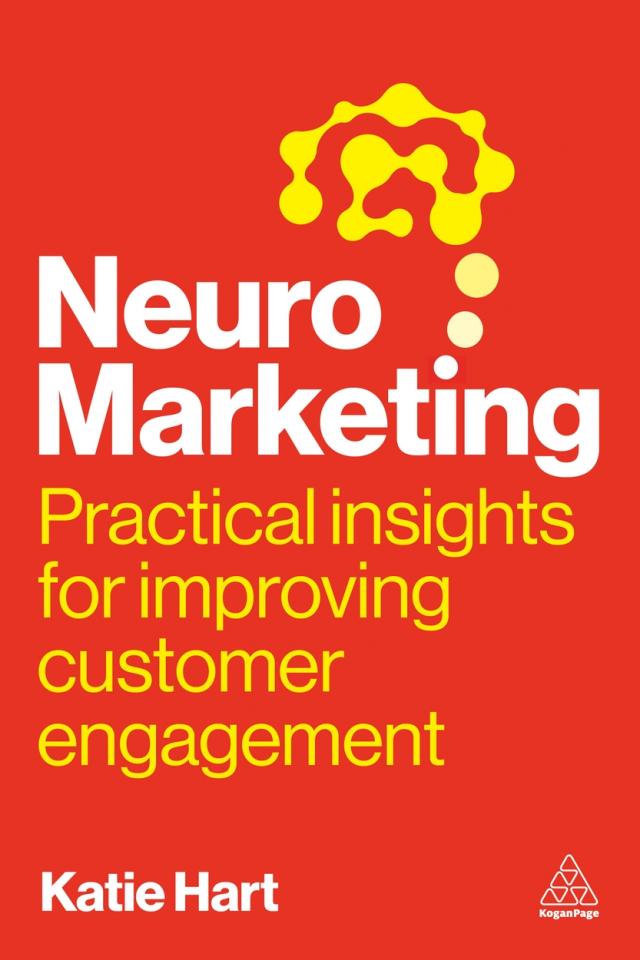 | Katie Hart: Hello, I'm Katie Hart, author of "Neuromarketing: Practical Insights for Improving Customer Engagement," published by Kogan Page. I've spent more than 15 years bringing neuroscience and psychology into marketing practice. In my book, I translate academic neuroscience into clear, actionable tools, covering attention, emotion, memory, and decision-making, alongside practical chapters on how each of the senses can be used to strengthen brand recall and shape consumer choice. You'll learn how to apply evidence-based techniques that improve engagement, optimize creative, and elevate your professional impact, drawing on original research I've conducted with leading brands. You can save 25% on "Neuromarketing" when you order directly from KoganPage.com. Just enter the exclusive promo code BIGEYE25 at checkout. Shipping is always complimentary for customers in the US and the UK. I hope my book helps you build campaigns grounded in how people actually think, feel, and decide. Thank you. |
Adrian Tennant: Welcome back. I'm talking with Katie Hart, author of the Bigeye Book Club's June selection, "Neuromarketing: Practical Insights for Improving Customer Engagement." Katie, you include a full chapter in your book about sound and music. What are the most common things brands get wrong when they think about audio, if they think about audio at all?
Katie Hart: Yeah, it's interesting, isn't it? Because this idea of sonic branding has been around for quite a while, and yet it doesn't seem to have really been taken to the lengths that I feel it could be. One of the first things that we need to accept is that sound does have a phenomenal impact in our brain, and particularly music. So, very often when we're talking about sound within the marketing arena, music is perhaps where we go to. There are so many elements that come into the sounds and the way that our brain responds to the sounds that it hears in the environment around it. So, for instance, the speed of the music, the pace of the music, if you like, changes us physiologically. And the music that's played in the background in a restaurant, for instance, can influence not only how much food we eat, but also how much tip we leave as well. So, these behaviors can be very significantly influenced. Being really intentional about the music we use, not just trying to make it catchy, but something that actually allows us to pick up the physiological responses that people will receive when they listen to it, is going to literally take that sonic branding to a whole new level.
Adrian Tennant: There's a real appetite among marketers right now for adding tactile, physical experiences back into the mix alongside digital channels. What does the neuroscience tell us about why physical materials land differently in the brain than the same content delivered on screen?
Katie Hart: I really applaud this shift backwards, I really do. And there's lots of reasons why things went digital and there was lots of excitement around it and there are lots of convenient and practical aspects to it. But it's really important that we accept that the brain does not respond to the same material presented digitally or in a tactile format, because it doesn't. We know through neuroscience that the brain struggles with information presented in a 2D format. So, if we watch something on a screen, it takes more energy from us, and so it's more cognitively draining. So, we get tired easier, and we may all have experienced that. back in lockdown days or if we still have lots of teams meetings and things. But actually, it's also harder for us to be able to recall that information and to be able to retain that information. So it affects our memory processes. The sort of core of this is the fact that when we look at something that is close to us, our eyes focus on something that is close to us. The angle of our eyes changes from when we are focusing on something which is away on the horizon and a long distance off. And actually, the angle of our eyes, the muscles that control that focus, sends a message to our brain. And when things are close to us, for a lot of our evolutionary past, that has meant we've needed to be hyper-vigilant, I suppose. Because whatever it is that we're seeing, it's immediate, it's urgent, it's in close proximity to us. Whereas something that's on the horizon a long way away is much more calm for us to consider and to process. So essentially, when we're looking at things in two dimensions on screens a lot, we are in this permanent, hyper-vigilant, sensitive state, dare I say stressed state, before we even go into what we might be reading or watching or what the particular nature of the content is. So there's lots of processes which get detrimentally affected within the brain because we are in what we perceive as being a sort of state of stress or perceived threat. Each of those affects us and how we interpret and how we engage with that digital content. Whereas the more tactile senses are really what we've relied on for most of our evolutionary past. Again, if you look at babies and children, they learn about their world by exploring it, by interacting with it, by putting it in their mouths, experimenting with it. And that is a lot of what we are still hardwired to do. So it's not natural for us to engage with information in the same way.
Adrian Tennant: One of your most disruptive ideas in the book, particularly for senior marketers whose careers have been built on segmentation and persona work, is that traditional approaches to understanding our audiences may need a fundamental rethink. You introduce a framework around three base fears: security, status, and strength. Katie, how does your framework change the way strategists should approach the way we define audiences?
Katie Hart: I think it's - I mean, I love the way you refer to it as being disruptive. That's not necessarily my intention, but it's about making sure that we are really drilling down as much as we can. I think very often when we look at the segments we create, the personas we develop, we've already evolved from being very sort of based in the demographics and we've comfortably moved on from that now. So we've become more involved in the sort of psychographic or the behavioral segments. But neuroscience allows us again to evolve that and take it on to another level. So we're no longer relying on what people tell us that they want or what they need, but we are drilling right down into what the fundamental part of their brain is motivated by. and these are much more compelling. They are much more likely to result in actions because these are essentially what our brains are looking out for. These are what they're triggered by. So if we can develop content or messaging or creative around solving some of these more fundamental aspects, they are going to not only be noticed more effectively, but they are also going to be much more likely to encourage us to engage and complete actions as a result of it. So it really is those fundamental elements around resources, threat, things that allow us to continue our survival and position us in a strong way to allow that survival to continue.
Adrian Tennant: Most of what we've discussed so far, of course, makes sense in consumer marketing, but your book argues that the principles apply equally in business-to-business contexts because the most influential parts of the brain don't change because someone happens to be at work. Katie, where do you see the biggest missed opportunity for business-to-business marketers, specifically?
Katie Hart: I think it's probably the area of personality. A lot of consumer brands are playing really nicely with their sort of brand personality, and they convey that in some very effective ways. But business-to-business marketing seems to either be playing it safe or almost feeling as if we don't need personality when we're making business-to-business decisions, and that is absolutely not the case. Bringing the personality element allows us to demonstrate a lot more about our brand and what we stand for and what's important to us. And that matters because, again, there is no part of our brain that is designed or dedicated to processing information about brands. So a lot of the mechanisms and the processes we use are those that are laid down for relationships. And usually those are human interactions that we're dealing with. So the more human that we can show our brands to be, the easier it is for brains to be able to engage with them, understand them, feel that they are seen, and feel that they are understood. It might feel a bit risky, and some industries may be more ready for this than others, but bringing personality through in the use of storytelling and emotions and sensual language, things like that, are a really rich opportunity that we're just not seeing within business-to-business marketing.
Adrian Tennant: In the final chapter of "Neuromarketing," you offer readers a 14-point implementation checklist. If a marketer reads the whole book and wants to put just one thing into practice on Monday morning, what's the single most significant change they can make?
Katie Hart: It might sound very simple, but I think the single most fundamental shift is putting your customer at the center of what you do. So positioning things from their perspective, whether that's the text that we use, writing it so that we're referencing you a lot more than we're talking about us and ourselves and our organization. But also in the imagery we use, it's a great device. It's a great kind of hack that we can use. We're actually taking the imagery from the customer's perspective. So, for instance, if we're selling a bike, a pedal bike, for instance, instead of using imagery, which takes that photograph from the side, which is sort of conventional way of a bike leaning up against a wall, actually using imagery, which is almost the kind of GoPro version of it. So someone's hands on handlebars as they're going down a mountain trail or something. That is the way the customer wants to experience being on that bike. That is going to be much more compelling. All the way through, put your customer right at the heart of the images, the selections that you make and the sort of language that you use too. This is where you can pick up on the phrasing and the language which comes out of those interviews that we were talking about earlier on.
Adrian Tennant: Your book references the influence of subtle environmental factors such as the warmth of a drink someone is holding or the scent in a room on how we evaluate the people and choices before us. For brand experience and retail teams, what's an example of a small environmental cue with disproportionate effect?
Katie Hart: There are all sorts of really fabulous examples of these, and they range from casinos in Las Vegas, which did some work with scent and smell and hit upon things by accident because they were originally just trying to mask the smell of tobacco and presumably bodies that have been sitting in that environment for a number of hours. under quite strenuous circumstances. So they played with pumping different smells into the casino environment and found that they could actually get people to play with significantly higher amounts of money. They would literally put 10% more into the slot machines, for instance, just by the shift of the smell. But for me, probably the biggest area is color. And there have been some fabulous examples, again, of where color is used to manage people's experience. And that can be to help them to navigate around a store. It can be to hold people in one place and move them on. There are also examples of where color has been used in very different environments from retail. So in a subway situation, just changing the lighting from a normal fluorescent lighting to one which has more blue hues in it, reduced suicide rates. So it can literally be life and death. And there's all sorts of examples about the color pink being used in prison environments as well to reduce the aggression of offenders. So we're not just talking about small impacts. Actually, if we use colour intentionally, we cannot only manage people's behaviours, but also their physiological state, so how they feel, how they experience things when they're in that environment. So there's so much potential for us to play with.
Adrian Tennant: Katie, you've taught neuromarketing to audiences ranging from major corporations to micro-businesses, plus the charity sector and even prison education programs. What's something you've learned about how this material lands with very different audiences?
Katie Hart: I think the beautiful thing and the thing that I feel inspired by, almost on a daily basis, is how excited we are to learn this sort of neuroscience content. Part of that is because we are also learning about ourselves, and in my experience, very often it tips over into learning about our partners and our children and explaining why they behave the way they do or why they frustrate us in the way that they do. There is a natural curiosity to us wanting to understand ourselves better, and neuroscience gives us a fabulous chance to do that. And It's a relatively new opportunity. For too long, neuroscience has really struggled to be able to give us the level of insights that we can now access. But as a result of advancements in technology, we can not only learn that about ourselves, but critically, we can make some huge insights into understanding our audiences, what motivates them, what their challenges are, how they feel, how they perceive things. And so there is a real wealth of information out there. And what I love is across all those different environments, people are curious, they're hungry, they're excited to see what they can learn and to really be able to take that away and use it to leverage greater results.
Adrian Tennant: Great conversation. Katie, if listeners would like to learn more about you, your work, or, of course, your book, "Neuromarketing," what's the best way of doing so?
Katie Hart: Probably through my website, which is katiehart.co.uk, or I'm also @neurokatiehart on both Instagram and TikTok.
Adrian Tennant: And a reminder that IN CLEAR FOCUS listeners can save 25 percent on "Neuromarketing" when you order directly from KoganPage.com using the promo code BIGEYE25 at checkout. Katie, thank you very much for being our guest this week on IN CLEAR FOCUS.
Katie Hart: My pleasure. It's been lovely to talk to you.
Adrian Tennant: Thanks again to my guest this week, Katie Hart, author of "Neuromarketing: Practical Insights for Improving Customer Engagement." As always, you'll find a complete transcript of our conversation with timestamps and links to the resources we discussed on the IN CLEAR FOCUS page at bigeyeagency.com. Thank you for listening to IN CLEAR FOCUS, produced by Bigeye. I've been your host, Adrian Tennant. Until next week, goodbye.
Timestamps
00:00: The Human Element in Branding
00:32: Introduction to In Clear Focus
00:54: Limitations of Traditional Market Research
01:25: Introducing Katie Hart
02:52: Motivation Behind Writing “Neuromarketing”
03:34: Understanding Non-Conscious Decision-Making
05:15: Value of Conventional Research Methods
06:40: Advancements in Physiological Research Tools
09:10: Case Studies in Neuromarketing
09:26: Repositioning a Brand for Success
11:01: Encouraging Return to the Workplace
12:29: The Power of Visual Processing
15:18: Effective Use of Contrast in Marketing
16:46: The Role of Sound and Music in Branding
18:15: The Impact of Tactile Experiences
20:25: Rethinking Audience Segmentation
22:58: Opportunities in B2B Marketing
26:18: Implementation Checklist for Marketers
28:01: Environmental Cues and Their Effects
30:15: Curiosity and Learning in Neuroscience
31:48: Connecting with Katie Hart
32:10: Closing Remarks